|
||||
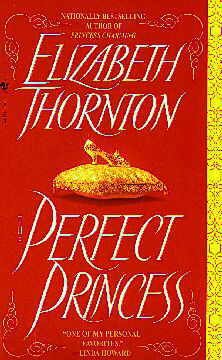 |
The Perfect Princess ISBN 0-553-58123-6 a thrilling sensuous tale of romance . . . the story of a woman who has almost given up hope of finding her noble hero until fate throws her unexpectedly into a breathtaking plot to save a scoundrel. Available now from Bantam Books |
|
Prologue Richard Maitland decided that he wasn't ready to die yet. Not that he had much say in the matter. A black mist was closing in on him. So this is what it's like to die, he thought. His brain was telling him to give up and go to sleep. Why was he fighting it? He was fighting it because his death would be ignoble, and his murderer or murderers would get away with it. They were clever and he'd played right into their hands. He was a lone wolf – a fatal character flaw according to Harper. In this instance, Harper was right. No one knew where he was. He hadn't thought to tell anyone because it wasn't important and had nothing to do with his work at Special Branch. Though his friends wouldn't accept the neat little scenario that had been laid out for him, they wouldn't know where to begin to look for answers to why he had to die. He wasn't sure he knew himself. Who would want him dead? His laugh turned into a dry, rasping cough, and he clamped his arm across his chest to stifle the stab of pain. He'd made enemies in his time, scores of them. Soldier; Agent, Chief of Staff of Special Branch – a man in his position attracted enemies like flies to a rotting corpse. Hard on that thought came another. Lucy. The black mist faded as his mind grappled with a burgeoning fear. Lucy. Where was she? What had they done with her? He remembered the boy . . . He could smell the blood. The air was ripe with it. Lucy's blood. His blood. He had to open his eyes, had to get his bearings. It seemed to take forever before his lashes lifted. Lights flickered. Shapes advanced and retreated. He frowned as he willed everything to come into focus. He was staring at a bed, and the half clothed body of the young woman who lay on top of it. Lucy. He thought his lungs would burst as he tried to scream his protest. This should never have happened. She was innocent. Her only crime was that she had known him. She was a prop in this grotesque drama. That's all she was to her killers, a prop to make his own murder seem more plausible. It was all coming back to him: the boy who had been waiting for him at the top of the stairs; the bastard who had stuck a knife in him; how they'd dumped him in this chair in a corner of the room and had left him to bleed to death. His hand was splayed against his chest, and something warm and sticky oozed between his fingers. He looked down. A large crimson stain was spreading across his shirt. If he didn't do something soon it would be too late. He couldn't pull himself to his feet, so he sank to the floor, on his knees, and used one arm pressed tight against his chest to staunch the flow of blood. Now that he was more awake, sensation was coming back, and his chest felt as though a red hot poker was lodged in it. Ignoring the pounding inside his head, he propelled himself forward on his knees, inch by painful inch, till he came to the edge of the bed. He groped with his free hand and found the pistol that had fallen between the mattress and the footboard. He had very little strength left, and though he knew it might be the death of him, he took his arm away from his chest and used both hands to cock the gun. Bracing his back against the bed, he aimed for the window and squeezed the trigger. The report of the shot sent waves of sound echoing from wall to wall. There were shouts from below, then the thundering of footsteps on the stairs. He had no way of knowing whether he'd summoned help or his would-be murderers. Either way, things did not look good for him. The mist was becoming
thicker and he had no more will or strength to fight it. It sucked
him under like a great black wave.
Chapter One"Why do you want to marry me, Michael?" No sooner had she asked the question than she regretted it. There was no point in prolonging the conversation. She knew she was going to refuse him. Now she would have to appear interested in his answer. "Prince Michael," he corrected automatically. "Because, Lady Rosamund, I think you'll make a perfect princess." A perfect princess. The words grated on Rosamund. That's what they were calling her in the newspapers, the perfect princess, ever since Prince Michael of the diminutive principality of Kolnbourg had made her the object of his attentions. And the depressing truth was, she probably would make a perfect princess. She was the daughter of a duke. She'd led a sheltered existence. From the day of her birth, she'd been trained in all the feminine arts, the ones that were essential for the wife of some gentleman from her own exalted sphere. She'd never been to school like other girls, or had beaux, or been kissed or had adventures. If only she'd been born a boy, things would have been different. She had two brothers, Caspar, the elder, and Justin, who was three years younger than she. They'd done exciting things. They'd each had a Grand Tour, and fought for king and country. They'd also done other exciting things she wasn't supposed to know about. La Contessa, that's what everyone was calling Caspar's latest mistress: haughty, expensive, and with the temper of a tigress. Rosamund's smile was fleeting. La Contessa's temperament would never do for a duke's daughter, of course. She'd been raised to be polite to everyone from His Majesty down to the lowest menial. She knew the rules of protocol back to front and inside out. She always knew where to sit at the dinner table when she was in exalted company, or whom she should curtsy to and whom she should not. Small-talk was her forte, except when her mind wandered, as it did from time to time, and she forgot where she was. If she had to describe herself in one word, it would be . . . insipid. Insipid. It was a word that had stuck in her mind, ever since Lady Townsend's ball, where she'd overheard some of the younger women discussing her character. No one could possibly dislike her, someone said, because she was as insipid as a blancmange. And everyone laughed. Her mother had been anything but insipid. By all accounts, Elizabeth Devere had been impatient with the constraints her exalted position had placed on her, and saw no reason to follow them slavishly. That was the trouble. She'd gone out riding alone and had taken a tumble while jumping a fence. It wasn't the accident that killed her, but the fact that she hadn't been found till the following morning. She'd come down with a fever and had quietly slipped away. Maybe, if her mother had lived, her grief-stricken father wouldn't have been so strict with his only daughter. And maybe, if her mother had lived, his only daughter wouldn't be feeling restless right now. All that had happened twenty years ago, but she still missed her mother. She wondered what her mother would think of the way her daughter had turned out if she could only see her now "Lady Rosamund?" Uh, oh. She'd done it again, forgotten where she was. She looked at Prince Michael and sighed. There must be something wrong with her, she thought. Prince Michael of Kolnbourg was tall, dark and handsome. He was also titled and legions of women had tried to lead him to the altar. Then why didn't he appeal to her? Perhaps, because she, too, was tall, dark and handsome as well as titled. She was also wealthy in her own right and no fool. It didn't take much intelligence to deduce that this was why Prince Michael had chosen to court her. Meanwhile, in another month, she would turn twenty-seven, and she knew her father was becoming desperate for her to accept one of her suitors. What she wanted, however, was a beau, not a suitor, someone who would like her for herself. Suitors, in her experience, were book-keepers – every asset was noted in their mental ledgers before they made an offer. Michael, Prince Michael, was definitely a suitor. He was only fourth in line to the throne and hadn't a sou to his name, a tragic circumstance when one considered his expensive tastes. Marriage to her would solve all his problems. They were in the conservatory of Twickenham House, the ducal mansion in Twickenham, just outside of London, and Rosamund took a moment or two to set the mood by staring at the vista through one of the windows. Autumn was ripe and mellow, and the trees were ablaze with color. "I'm an English girl," she said. "I could never be happy transplanted to a foreign shore." She looked over her shoulder and caught him in the act of studying his watch. Evidently, she bored him as much as he bored her. That didn't surprise her. Lady Rosamund Devere was a boring sort of person. That's what came of being a duke's daughter. She'd been raised to be as bland as a blancmange. And that's exactly the kind of wife Prince Michael wanted. The perfect princess, the bland blancmange, who could be counted on never to put a foot wrong, say a wrong word or have an original thought. Without awkwardness or embarrassment, he slipped his watch inside his vest pocket and gave her one of his engaging smiles. "I have no objection to your remaining in England after we are wed," he said. "In fact, I may decide to make England my home. The climate agrees with me." So did the actresses, but she wasn't supposed to know about them. She gave him one of her own engaging smiles. "I'm almost tempted, but . . . " "But?" "You can't play chess, your Highness. And I could never marry a man who cannot play chess." And that was that. Copyright © Bantam Books
|
home | profile | newsletter | new release | my books | articles on writing | get published |
©October 2001 Elizabeth Thornton All Rights Reserved. |